
GENERAL
Chart Supplement: The Pilot’s Ultimate Navigation Companion


A chart supplement is an essential resource in aviation, offering a consolidated reference for pilots navigating various airspaces. Often referred to as a comprehensive airport directory, it provides detailed information about airports, heliports, navigational aids, communication frequencies, runways, services, and special operational procedures. Updated regularly—every 56 days in the United States—this publication ensures pilots have access to the latest and most relevant data for safe and legal flights.
Unlike sectional charts that emphasize airspace and topography, this supplement includes operational specifics necessary for decision-making on the ground and in the air. It’s an indispensable part of preflight planning, emergency preparedness, and compliance with aviation standards.
Evolution of the Aviation Directory
Once known as the “Airport/Facility Directory,” this tool has evolved significantly. It now encompasses detailed diagrams, procedural notes, and robust indexing, making it more user-friendly and informative. The transition from print to digital formats further reflects how aviation has embraced technological advancement, allowing pilots to integrate these directories into electronic flight bags (EFBs).
Digital access has improved usability and search functions, yet many aviators still prefer printed editions for their reliability during electronic outages.
Why Every Pilot Relies on This Navigation Guide
The utility of this publication goes beyond just convenience. It is vital for:
- Accurate Operations: Offers specific airport data including lighting systems and taxiway layouts.
- Regulatory Adherence: Includes NOTAMs, approach procedures, and remarks.
- Effective Planning: Aids in route planning with information on fuel availability and customs.
- Emergency Options: Provides alternatives for landing due to weather or technical issues.
- Clear Communication: Lists essential radio frequencies for seamless communication.
Pilots are urged to use this publication during their preflight checks to ensure they are informed and prepared.
Key Features of Chart Supplement
Airport Layouts
Detailed airport diagrams present the configuration of runways, taxiways, and parking ramps. These diagrams help reduce the risk of ground navigation errors.
Runway Specifications
Crucial data includes runway dimensions, surface types, load-bearing capabilities, and declared distances. These elements help pilots perform accurate takeoff and landing calculations.
Communication and Navigation
Includes frequencies for tower, ground control, ATIS, and other services. Having this information readily available streamlines communication and minimizes delays.
Available Services
Provides details on fuel types, maintenance availability, ground transportation, and pilot amenities. This helps in choosing suitable airports for both planned and diversionary landings.
Operational Notices
Lists relevant procedures and warnings such as noise restrictions, special use airspace, or parachuting zones to maintain safety and compliance.
Comparison Table: Chart Supplement for Pilots
| Feature | Chart Supplement | Sectional Chart | EFB Apps | Airport Listings | GPS Units |
| Cost | Low | Moderate | Subscription | Free (basic) | High |
| Efficiency | High | Medium | Very High | Low | Medium |
| Ease of Use | Moderate | High | High | Moderate | High |
| Update Frequency | Every 56 days | Every 6 months | Real-time | Occasionally | Manual |
| Data Depth | Extensive | Limited | Varies by source | Minimal | Basic |
| Offline Accessibility | Yes | Yes | Often yes | No | Yes |
Practical Uses in Aviation
Strategic Planning
Before flights, aviators consult this reference to confirm runway lengths, lighting, and fuel availability. This is especially useful for VFR pilots planning cross-country trips.
Handling Emergencies
In case of diversions, this publication helps identify the nearest viable landing spots with required facilities and safe runways.
Avoiding Restricted Airspace
Pilots use this tool to ensure they are not violating military or controlled airspace, as it outlines detailed procedures and contact info for such zones.
Expert Tips for Maximizing Its Value
- Always Confirm the Edition Date: Outdated data can compromise safety.
- Use Bookmarks or Notes: Mark high-use airports for quick reference.
- Pair With NOTAM Checks: Supplements may not reflect temporary changes.
- Practice Diagram Reading: Familiarity with layouts enhances ground movement efficiency.
- Keep a Backup Copy: Even in the digital age, having a printed version adds redundancy.
Digital Integration and Technological Advances
In modern cockpits, many pilots access this guide through EFBs or aviation apps. This integration allows for rapid search and real-time updates. Despite this convenience, instructors and seasoned aviators still emphasize the importance of maintaining a physical copy for redundancy.
Veteran flight instructor Captain Sarah Myers notes, “Technology boosts efficiency, but having a hard copy on hand ensures you’re never left without critical data during equipment failures.”
Aviation Safety and Compliance
Regulatory bodies mandate that pilots familiarize themselves with all relevant data before departure. Failing to do so can lead to violations or accidents. During checkrides and exams, knowledge of this publication is essential and regularly tested.
Using it effectively demonstrates professionalism and preparedness—qualities that are highly valued in both commercial and private aviation sectors.
What the Future Holds for Chart Supplements
The future of this aviation guide looks increasingly digital. Innovations may soon include:
- Artificial Intelligence Integration: Automated updates with real-time alerts.
- Augmented Reality Displays: Overlaying critical airport data via AR in headsets.
- Voice-Activated Searches: Enabling hands-free information access during flight.
Despite these advances, its foundational role in aviation is unlikely to diminish. The reliability and completeness of data make it a cornerstone for safe operations.
Conclusion
Whether you’re a student pilot or a seasoned captain, having access to a chart supplement ensures your flights are well-informed, compliant, and secure. It’s more than just a directory—it’s a tactical asset that enhances every phase of flight. In an age dominated by technology, its reliable structure and critical data offer peace of mind that no pilot should fly without.
FAQs
What’s included in a standard aviation chart supplement?
It typically contains airport data, communication frequencies, diagrams, and procedural notes.
How often should a pilot check for updates?
Every 56 days, or more frequently if flying in unfamiliar regions.
Are mobile versions of this guide trustworthy?
Yes, if sourced from certified aviation applications and updated regularly.
What’s the best way to learn how to use this tool?
Practice reading it during preflight planning and consult instructors or training materials for deeper insights.
Can chart supplement help during diversions?
Absolutely. It provides vital information for locating alternate airports and planning safe landings.
Is it legally required for VFR pilots?
Not always, but it is highly recommended for safety and regulatory awareness.
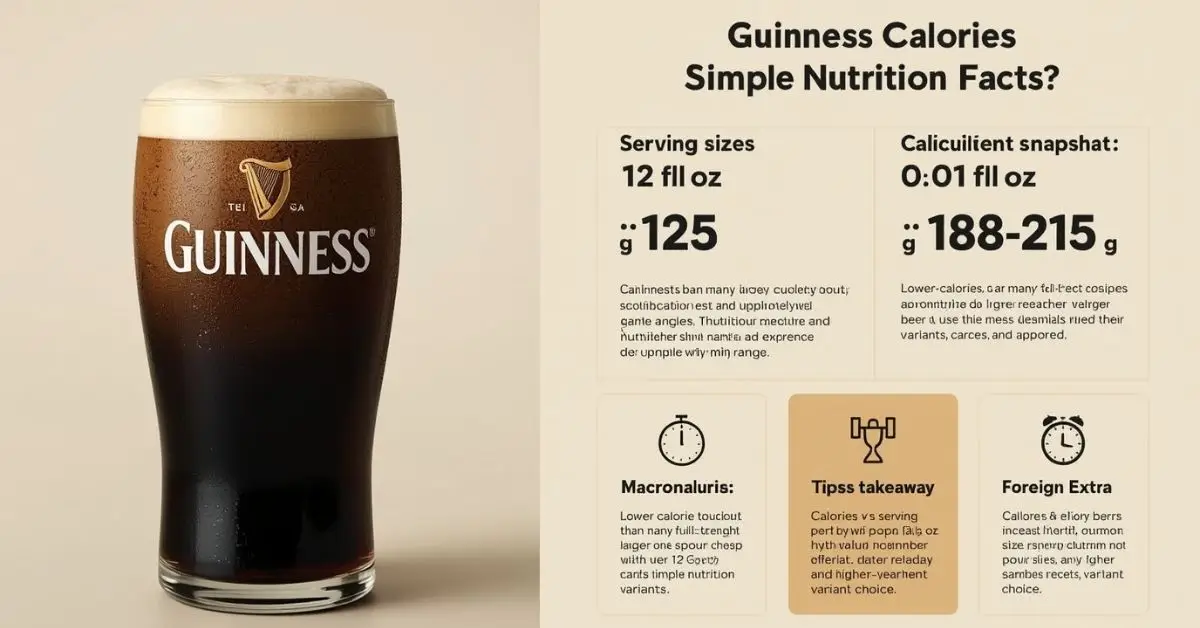
Ever wonder if your beloved pint is sneaking in more calories than you’d like? You’ve been there. I’ll help you understand [guinness calories] the smart way—no fluff, just real-world facts and easy clarity.
Quick Answer
A pint (16 oz) of Guinness Draught has about 210 calories (about 35 kcal per 100 ml). Calories come mainly from alcohol and carbs. Simple, direct, no guesswork.
What’s in a 12-oz Guinness Draught?
This tells you exactly what’s in a standard serving.
You’ll learn the facts fast:
- 12 oz (~355 ml) of Guinness Draught has 125 calories (Alcohol 11.2 g, carbs 10 g).
- That’s ~35 kcal per 100 ml for Guinness Draught or Extra Stout. A full pint rounds to ~210 calories total.
Key Intake: A full pint = ~210 kcal; most calories come from alcohol.
How Do Variants Stack Up?
See how different types compare no guessing here.
| Variant | Calories (per 12 oz) | Key Notes |
| Draught | ~125 kcal | Standard, smooth |
| Foreign Extra Stout | ~194 kcal | Rich, roasty |
| Baltimore Blonde Lager | ~167 kcal | Hoppy, lighter |
| Guinness Smooth (per 100 ml) | ~57 kcal (~217 kcal pint) |
Key Intake: Higher ABV = more calories. Pick the one that fits your macro budget.
Why Calories Vary Breakdown by Source

Learn where the calories come from, not just numbers.
- Alcohol has 7 kcal per gram; in Draught, ~62% of calories are from alcohol.
- Carbs add the rest—around 10 g in a 12-oz Draught (~40 kcal).
Key Intake: Calories split roughly 60% alcohol, 40% carbs.
Non-Alcoholic and Low-Cal Alternatives
Find choices when you want flavor without the calorie hit.
- Guinness 0: only 17 kcal per 100 ml (≈ 68 kcal per pint).
- Good picks if you’re tracking macros or avoiding alcohol.
Key Intake: Guinness 0 is a clever low-calorie swap for your pint fix.
What This Means for Dieters & Health-Mindful Drinkers
A quick guide to fit Guinness into your nutrition plan.
- A pint ~ 210 kcal is moderate—less than many craft ales (160–180 kcal).
- If counting macros, know: alcohol is the main calorie source.
Key Intake: It’s not “diet-friendly” but moderate and trackable.
Final Takeaway
This isn’t sugar-coated. If you’re watching your calories, understanding “guinness calories” means choosing wisely, knowing exactly what’s in your pint, and fitting it into your wellness plan like a smart decision, not a hidden cost.
FAQ’s
How many calories are in a pint of Guinness?
~210 kcal per pint, based on ~35 kcal per 100 ml.
What’s the calorie content of a 12-oz Guinness Draught vs Extra Stout?
Draught ~125 kcal; Extra Stout ~180–194 kcal.
Are there lower-calorie alternatives to Guinness stout?
Yes—Guinness 0 has only ~17 kcal per 100 ml (≈ 68 kcal per pint).
Guinness calories vs Bud Light: which is lower?
Guinness Draught (~125 kcal) is similar or slightly higher than Bud Light (~110 kcal).
How many calories per gram of alcohol are in Guinness?
Alcohol contributes 7 kcal per gram; ~60% of calories in Draught come from alcohol.
Calories in Guinness Draught nutritional facts explained?
~125 kcal from alcohol (78 kcal) + carbs (~40 kcal), plus ~1 g protein.
Is Guinness high in calories for a diet plan?
It’s moderate; track it, and it can fit in but be mindful of alcohol calories.
Expert Citations
- Healthline: Detailed breakdown of calories from alcohol vs carbs in Guinness Draught.
- Guinness.com: Official calorie counts across variants (Draught, Extra Stout, 0.0, etc.).
- Guinness product pages: Precise nutrition data for each variant – Draught, Foreign Extra Stout, Blonde, Smooth, etc.

Golf can be cruel. One minute you’re leading the Masters, the next you’re fighting to hold it together. Rory Masters collapse moments have given fans drama, heartbreak, and unforgettable TV.
We’ve all seen it happen, the missed shots, the tense body language, the scoreboard slipping away. But why does it happen to a player as good as Rory McIlroy? Let’s break it down.
Quick Answer
The Rory Masters collapse refers to multiple high-profile moments at Augusta where Rory McIlroy lost his lead, most famously in 2011 when he shot 80 in the final round, and again in 2025 with late-round bogeys. Causes include mental pressure, course difficulty, and external distractions like slow play. Yet, Rory has also turned these failures into motivation, ultimately winning the Masters in 2025 to complete his career Grand Slam.
Rory McIlroy: Masters Career Profile
| Category | Details |
| Name | Rory McIlroy |
| Date of Birth | May 4, 1989 (age 36) (ESPN.com) |
| Hometown | Holywood, Northern Ireland (ESPN.com) |
| Turned Pro | 2007 (ESPN.com) |
| Masters Titles | 2025 (First win; career Grand Slam completed) (Reuters, The Washington Post) |
| Notable Collapses at Masters | 2011 final-round meltdown (80, from 4-shot lead) (Wikipedia) |
| Masters Attempts Before Win | 17 attempts at Augusta by 2025 (The Sun) |
| Other Major Wins | U.S. Open 2011, PGA Championship 2012 & 2014, Open Championship 2014 (Data Golf, Wikipedia, Reuters) |
| Total Career Wins (2025) | 44 total: 29 PGA Tour, 18 European Tour, others (Talksport) |
| Career Grand Slam | Achieved with 2025 Masters win; one of six to do so (Reuters, Talksport) |
| Signature Moment | Emotional collapse to celebrating Green Jacket after playoff win vs. Justin Rose (The Washington Post) |
| Key Strengths | Multiple Majors, career Grand Slam, long-time world No.1 (European Tour, Reuters) |
| Resilience & Legacy | Climbed back from 2011 collapse to claim Masters, completing a decade-long quest (The Scottish Sun, Reuters) |
2011 The Collapse That Started It All
The first big Rory Masters collapse came in 2011.
- Rory led by four shots after three rounds.
- On Sunday, Augusta’s pressure took over.
- He shot an 80 and finished tied for 15th.
2025 A New Collapse, Same Augusta Pressure
Fast forward to 2025. Rory was 4-under through 14 holes in Round 1.
- Then came bogeys on 15 and 16.
- A double bogey on 17 sealed the damage.
Paul McGinley, former Ryder Cup captain, called it a slow play distraction McIlroy couldn’t shake. This wasn’t the first time Rory felt Augusta’s mental toll.
Why Collapses Happen at Augusta
Definition:
Mental collapse in golf Majors is when focus, rhythm, and execution fall apart under tournament stress.
Augusta National tests more than swing mechanics. It pushes the mind to breaking point.
Key factors:
- Course design: punishes tiny errors.
- Crowd energy: amplifies every mistake.
- Mental game: pressure spikes near the finish.
Rory’s Redemption 2025 Masters Win
Here’s the twist: despite the early stumble, Rory fought back. By Sunday evening, he wore the green jacket.
- He became only the 6th golfer to complete the career Grand Slam delay McIlroy had chased for over a decade.
- His win proved collapse doesn’t have to define you.
What Fans and Players Can Learn
- Stay present: Focus on one shot at a time.
- Adapt fast: Don’t let a bad hole become a bad round.
- Pressure prep: Simulate high-stakes moments in practice.
Real-world note:
I’ve seen players choke in local tournaments because they never practiced the mental side. Rory’s story shows why it matters.
FAQs
Why is Rory McIlroy’s Masters collapse famous?
It’s remembered for how quickly a winning position turned into a blowout, especially in 2011 when he led by four shots.
How many times has Rory collapsed at the Masters?
At least twice in high-profile ways — 2011’s final-round meltdown and the 2025 early-round stumble.
What caused Rory’s 2025 collapse?
Analysts point to mental pressure and slow play distractions from his group.
Has Rory ever recovered from a Masters collapse?
Yes. He won the Masters in 2025, securing his career Grand Slam.
Expert Citations
- Paul McGinley — TalkSport: “Slow play affected Rory’s rhythm.”
- Golf.com — “Analyst says slow play led to Rory’s Masters collapse.”
- Wall Street Journal — “McIlroy completes career Grand Slam with 2025 Masters win.”

You’re curious, and honestly—so am I. What’s it like to own a slice of Caribbean magic, hidden away from prying eyes? Especially when that slice belongs to a Hollywood legend. Let’s cut through the noise and get real.
Quick Answer
Johnny Depp’s Island is called Little Hall’s Pond Cay. He bought it in 2004 for about $3.6 million. It spans roughly 45 acres and is 60 miles southeast of Nassau in the Bahamas. He still owns it as of mid-2025.
Where is Johnny Depp’s Island located?
Here’s what you’ll learn: Its geography, how big it is, and where it sits in paradise.
- Located in the Exuma Islands, Bahamas, about 60 miles southeast of Nassau (Tuko.co.ke – Kenya News, Market Realist, News).
- Covers roughly 45 acres (18 hectares), a sizable tropical property with six beaches (Tuko.co.ke – Kenya News, Newszetu).
It’s a mid-size tropical hideaway, a boat-ride from Nassau. Pure, quiet, untouched.
What’s the story behind its name and purchase?
Here’s what you’ll learn: Why Johnny Depp bought it, what he named parts of it, and how he transformed it.
- Johnny Depp Island was discovered while filming Pirates of the Caribbean. He bought it in 2004 for about $3.6 million (Vanity Fair, News, Homes & Gardens).
- The six beaches are named after his loved ones and mentors—Gonzo (Hunter S. Thompson), Lily Rose, Jack, Brando (Marlon Brando), and Paradis (Vanessa Paradis) (Vanity Fair, Market Realist, People.com).
- He built a ranch-style main house with 360° views, solar-powered guest structures, a bamboo yurt, and a beach house—low-key luxury meets eco-sensitivity (DDW, Tinseltown Tales, DMARGE, CEO Today).
What makes it a sanctuary—and does Depp still own it?
Here’s what you’ll learn: Why it’s meaningful to Johnny Depp and if he still owns it.
- Depp calls Johnny Depp Island “pure and beautiful” and says you can feel your “pulse drop” there—instant freedom (Vanity Fair, Newszetu, Tinseltown Tales).
- As of mid-2025, he still owns it despite rumors of a sale to J.K. Rowling (CEO Today).
Celebrity & luxury context
Here’s what you’ll learn: How it fits with celeb real-estate and pop culture.
- Johnny Depp Island sits among other Bahamas celebrity islands, near properties owned by Eddie Murphy and David Copperfield (Tuko.co.ke – Kenya News).
- The island has hosted Depp’s wedding to Amber Heard in 2015 and served as a detox retreat during difficult times (Glamour, DMARGE, Market Realist).
Takeaway
From celebrity news readers to luxury travellers to real-estate enthusiasts, Little Hall’s Pond Cay—better known as Johnny Depp Island—is a rare, personal hideout that blends Depp’s eclectic style with genuine peace. Based on real-world reports and Depp’s own words, this island is more than property—it’s sanctuary.
FAQ’s
Where is Johnny Depp’s island located?
A private island called Little Hall’s Pond Cay, in the Exuma chain, 60 miles southeast of Nassau, Bahamas.
What is the name of Johnny Depp’s private island?
It’s called Little Hall’s Pond Cay.
How much did Johnny Depp’s island cost?
He bought it for around $3.6 million in 2004.
Can you visit Johnny Depp’s island in the Bahamas?
No—access is strictly by invitation only.
What’s the history of Johnny Depp’s Little Hall’s Pond Cay?
He discovered it during Pirates of the Caribbean filming, bought it, built eco-homes, and still owns it as of 2025.
What are some luxury aspects similar to this island?
Think celebrity-owned private islands—secluded, bespoke retreats designed for quiet, high-end living.
Expert Sources
- Vanity Fair – Their coverage on Johnny Depp Island includes direct quotes and historical context from the actor himself. (vanityfair.com)
- People Magazine – Their article on Johnny Depp Island offers fact-checked property details and insider background. (people.com)
- Homes & Gardens – A respected home and lifestyle publication that provides credible real-estate insights, including luxury property features and valuations for celebrity-owned estates. (homesandgardens.com)
-

 GENERAL10 months ago
Waterless Skincare: The Future of Potent, Eco-Friendly Beauty
-

 GENERAL10 months ago
Gary Brecka Supplements: Unlocking Peak Human Performance
-

 HEART TIPS9 months ago
Common Heart Home Health: Trusted Cardiac Care at Home
-

 GENERAL9 months ago
Activia Yogurt Nutrition Facts You Shouldn’t Ignore
-

 WORKOUTS10 months ago
Butt Exercise Machine: Intelligent Exercises to Change Your Glutes
-

 HEALTHY DIET9 months ago
Arbonne 30 Days to Healthy Living
-

 GENERAL10 months ago
Healthy Living at Home for a Better You
-

 HEART TIPS9 months ago
Heart Home Health Care: A Lifeline of Medical Excellence